

Yarn Twist Tester Operation Analysis
Yarn twist is a core quality indicator in textile production, directly affecting fabric strength, elasticity, and appearance. As a key piece of equipment in modern textile laboratories, the electronic yarn twist tester achieves standardized and data-driven twist measurement through high-precision sensors and an automated control system.
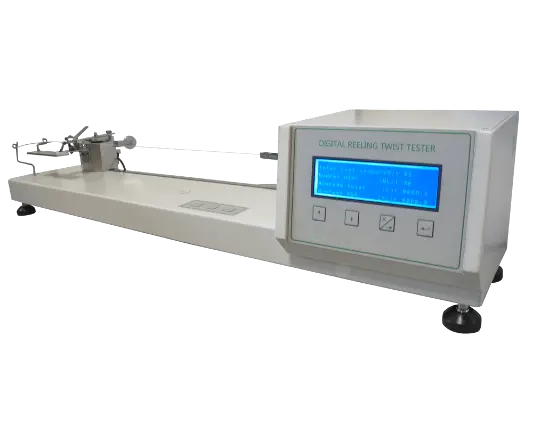
Structure and Function
The electronic yarn twist tester consists of five core components:
Mechanical Clamping System: Employing a double-clamp design, the left side is a fixed yarn holder, and the right side is a rotating chuck, fixed to the base plate with bolts. A horizontal tension adjustment device and yarn guide hook are installed above the base plate to ensure stable yarn tension during testing.
Drive and Transmission System: The rotating chuck is driven by a stepper motor, achieving stepless speed control (100-2000 rpm), and with an imported dedicated clock circuit, ensures a speed accuracy of ±0.5%.
Tension Loading System: Employs a horizontal weight loading method, supporting tension adjustment within the range of 1-5000 grams to meet the testing needs of various yarn materials such as cotton, wool, and synthetic fibers.
Data Acquisition System: Features a built-in high-precision torque sensor and angle encoder to monitor torque changes and rotation angles during yarn untwisting in real time, with a sampling frequency of 1000 times/second.
Intelligent Control System: Based on a microprocessor architecture, equipped with a 5.7-inch color touchscreen, supporting a bilingual (Chinese and English) operating interface, capable of storing 4GB of test data and generating Excel format reports.
Operating Procedure
(I) Pre-Test Preparation
Environmental Calibration: Place the instrument in a constant temperature and humidity environment of 20±2℃ and 65±5% for 30 minutes until the system stabilizes.
Parameter Settings:
Test Method Selection: Supports direct counting method (F0), untwisting-twisting method (F1), double untwisting method (F2), and triple untwisting method (F3).
Test Length Setting: Adjustable from 10-500 mm. For synthetic filaments, 500 mm is recommended to reduce edge effects.
Pre-tension Configuration: Set according to yarn linear density (Tex value) according to ISO 2061 standard. For example, for 20Tex cotton yarn, a 50-gram weight is recommended.
Sample Installation:
Fix both ends of the yarn sample to the left and right clamps respectively, ensuring the yarn axis coincides with the rotation axis.
Use the yarn guide hook to guide the yarn through the tension device to prevent slippage during the test.
(II) Test Execution Stage
Start the Test: Select the "Start" button on the touchscreen. The system will automatically execute the following steps:
Rotate the chuck in the set direction (S-twist or Z-twist) to accelerate to the target speed.
Collect torque and angle data in real time. Automatically stop when the yarn is completely untwisted.
Reverse the rotation of the chuck to add twist, recording the peak retwisting torque.
Data Recording:
After a single test, the screen displays the twist value (twists/meter) and twist coefficient (T×Tex^2). 0.5) and Coefficient of Variation (CV%)
The system automatically stores test data and supports categorized management by batch, date, yarn type, etc.
Batch Testing: Connecting to a computer via RS232 interface allows for continuous testing of up to 200 samples, with test intervals set from 5 to 30 seconds.
(III) Post-Test Processing
Sample Disposal: Tested yarn samples should be stored separately to avoid contamination and subsequent analysis.
Equipment Cleaning: Use a soft brush to remove fiber debris from the clamps and guide hooks. Do not use organic solvents to wipe optical components.
Data Export: Transfer test reports to the quality management system via USB interface or LAN to generate quality inspection files conforming to ISO 9001 standards.
Precautions
Tension Control:
Insufficient pretension can cause yarn slippage, while excessive pretension may lead to fiber breakage. Dynamic adjustment based on yarn material is necessary.
When testing synthetic filaments, it is recommended to use a segmented loading method. First, apply 50% of the rated tension, and then increase to full load after the system stabilizes.
Speed Matching:
For coarse yarns (e.g., below 10Tex), a low-speed mode (≤500 rpm) is recommended to avoid centrifugal force causing testing errors.
For fine yarns (e.g., above 100Tex), a high-speed mode (≥1000 rpm) can be used to shorten the testing cycle.
Abnormal Handling:
If a sudden torque change or abnormal angle occurs during testing, the system will automatically trigger an alarm and stop operation.
In case of yarn breakage, the sample must be reinstalled and the zero point calibrated before testing can continue.
Calibration Cycle:
Torque Sensing The instrument is recommended to be calibrated every 3 months using standard weights for three-point calibration (25%, 50%, and 75% of the range).
The angle encoder should be calibrated annually, with linearity measured using a laser interferometer.
Development Trends
With the development of IoT technology, the next generation of twist testers is evolving towards intelligence:
Cloud Interconnection: Remote equipment monitoring via 5G modules allows quality engineers to access test data from factories worldwide in real time.
AI-Assisted Analysis: Built-in machine learning algorithms automatically identify abnormal twist fluctuation patterns and predict equipment failure risks.
Multi-Parameter Linkage: Integrating tension-twist-strength joint testing modules establishes a comprehensive yarn performance evaluation system.
As a key piece of equipment for textile quality control, the standardized operation and precise maintenance of electronic yarn twist testers directly affect product quality. By strictly adhering to operating procedures and regularly calibrating equipment parameters, enterprises can significantly improve production efficiency and product competitiveness, providing technical support for the high-quality development of the textile industry.