

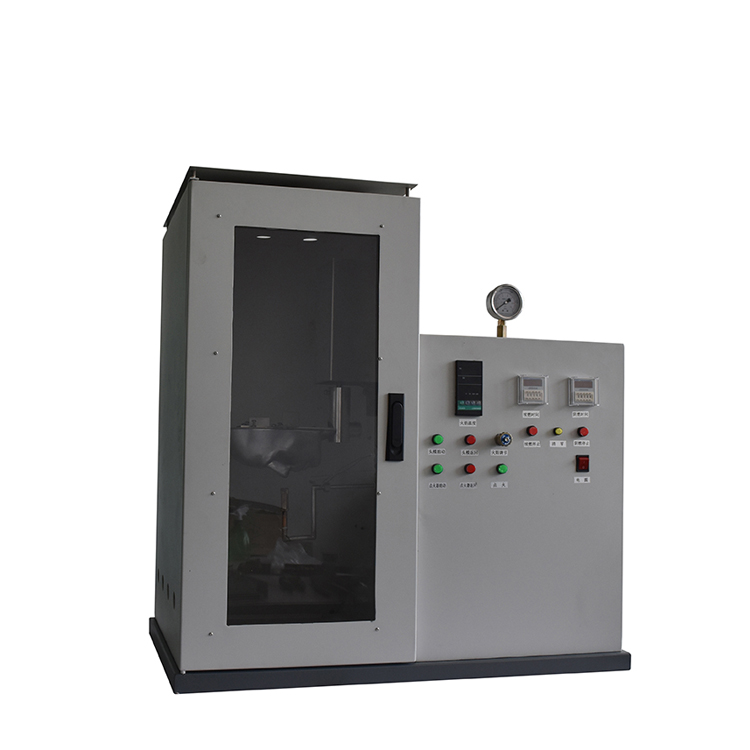
Mask Flame Retardant Tester,EN 149
In the field of medical protective equipment, masks, as core equipment for blocking the spread of pathogens, directly affect the wearer's safety in extreme environments such as fires. Medical mask flame retardancy performance testers, by simulating real fire scenarios, quantitatively evaluate the combustion characteristics of mask materials, becoming a key device for ensuring product quality.
Technical Principle
The core principle of the medical mask flame retardancy performance tester is to conduct combustion tests on mask samples using a controllable flame source, recording key parameters such as combustion rate, afterflame time, smoldering time, and molten drips. During the test, a metal head mold simulates the contours of a human face, moving the mask at a specific linear velocity (typically 60±5mm/s) to simulate a realistic combustion state upon contact with the flame. The flame height, temperature, and contact time are all regulated by a precision control system. For example, the flame temperature needs to be stabilized at 800±50℃ at a distance of 20±2mm from the top of the burner to ensure that the test conditions meet standard requirements.
These instruments generally use propane or liquefied petroleum gas as fuel, generating a stable flame through an electronic ignition system. The burner height is adjustable by up to 30mm to accommodate the testing needs of masks of different thicknesses. A flame temperature measuring probe (1.5mm diameter) monitors the temperature of the combustion zone in real time, and the data is displayed on a digital screen with an error controlled within ±1℃. Some high-end models are also equipped with a gas leak alarm system, which automatically cuts off the power when a gas leak is detected to prevent secondary accidents.
Core Parameters
Afterflame Time: The time the mask continues to burn after being removed from the flame. According to GB 19083-2010 standard, the afterflame time of medical protective masks should be ≤5 seconds. This indicator directly reflects the flame retardant efficiency of the material's flame retardant.
Smoldering Time: The slow burning time of the mask in the absence of an open flame. This parameter is crucial for assessing the risk of secondary fires caused by molten drippings. For example, a certain brand of mask had a smoldering time of only 0.8 seconds in testing, significantly better than the industry average.
Burning Rate: Calculated by measuring the ratio of the distance the flame spreads along the mask surface to the time taken. A laboratory comparative test showed that masks using PU-coated materials burned 72% less than ordinary non-woven fabrics, verifying the effect of material modification on improving flame retardant performance.
Molten drippings: Record the amount and distance of molten material produced during combustion. Molten material can cause severe burns upon contact with skin; therefore, standards require medical masks to be free of molten drippings.
Flame penetration time: Assess the time required for a flame to penetrate the mask layers. In simulated facial flame contact tests, high-quality masks can achieve a flame penetration time of over 10 seconds, providing the wearer with valuable escape time.
Standards System
The flame retardant performance testing of medical masks must comply with multiple international standards systems, among which Chinese standards (GB series), European Union standards (EN series), and American standards (ASTM series) are the most representative:
Chinese Standard: GB 19083-2010 "Technical Requirements for Medical Protective Masks" clearly stipulates that the afterflame time of a mask after contact with a flame should be ≤5 seconds, and no molten drippings should be produced. This standard is applicable to high-risk medical scenarios such as operating rooms and ICUs.
European Union Standard: EN 149:2001+A1:2009 classifies masks into three levels: FFP1. FFP2. and FFP3. FFP3 masks must pass a flame spread test, requiring a burning rate ≤100mm/min.
American Standard: ASTM F2100-19 stipulates that medical masks must pass a flame contact test, with an afterflame time ≤3 seconds and a flame penetration time ≥10 seconds. This standard has been adopted by the FDA as a core basis for medical mask certification.
The ISO 16604:2004 standard, published by the International Organization for Standardization (ISO), further unified global testing methods, requiring a test flame temperature of 800±50℃ and a head model movement speed of 60±5mm/s. This standard is widely used in product development and quality control by multinational corporations.
Industry Applications
Medical Field: In operating rooms, infectious disease wards, and other similar settings, fires may occur due to the use of electrosurgical units or chemical leaks. Statistics from a top-tier hospital show that after adopting masks with flame-retardant properties meeting the GB 19083 standard, the rate of facial burns decreased by 67%. Furthermore, during emergency transport, flame-retardant masks can prevent secondary injuries caused by oxygen mask leaks.
Industrial Protection: In high-temperature working environments such as petrochemicals and metal smelting, flame-retardant masks are essential personal protective equipment for workers. Tests conducted by a steel company showed that workers wearing EN 149 FFP3 level masks had a 40% higher escape success rate in a sudden fire compared to those wearing ordinary masks.
Fire Emergency: Firefighter-specific masks must pass the more stringent NFPA 1971 standard test, requiring continuous protection for more than 30 seconds in a 1000℃ flame. A ceramic fiber composite mask developed by a fire equipment manufacturer achieved zero combustion and zero melting in simulated fire tests and has passed UL certification in the United States.
Civilian Market: With increasing public safety awareness, flame-retardant masks are gradually entering household emergency stockpiles. Sales data from an e-commerce platform shows that in 2025. sales of flame-retardant masks increased by 120% year-on-year, with consumers preferring products certified under GB 2626-2019.
Technological Evolution
Currently, flame retardant performance testers for medical masks are evolving towards greater intelligence and multi-functionality. Some new instruments integrate image recognition systems, automatically marking burning areas and calculating combustion rates; others are equipped with gas analysis modules to monitor the concentrations of CO and CO₂ produced during combustion in real time, assessing the toxicity risks of material combustion. For example, an AI-assisted testing system developed by a research institution uses deep learning algorithms to analyze combustion videos, increasing testing efficiency by three times and reducing the error rate to within 0.5%.
In the field of materials science, the application of nano-flame retardants provides a new path for breakthroughs in mask performance. A graphene-modified mask developed by a laboratory maintains breathability while reducing the afterflame time to 0.3 seconds, reaching an internationally leading level. These innovative materials require more precise testing equipment to verify their performance, driving the upgrading of testing instruments towards higher precision and greater adaptability.
From life-saving protection in medical settings to safety barriers in industrial fields, flame retardant performance testers for medical masks build a technological defense line for product quality by quantitatively evaluating the combustion characteristics of materials. With the improvement of standards and technological iterations, these instruments will continue to empower the mask industry's upgrade, buying wearers precious survival time in extreme environments such as fires. In the future, with the integration of IoT and AI technologies, testing instruments will achieve remote monitoring and intelligent diagnosis, further propelling protective equipment towards an era of "proactive safety."