

What is a High Speed Lockstitch Bar Tacking Machine?
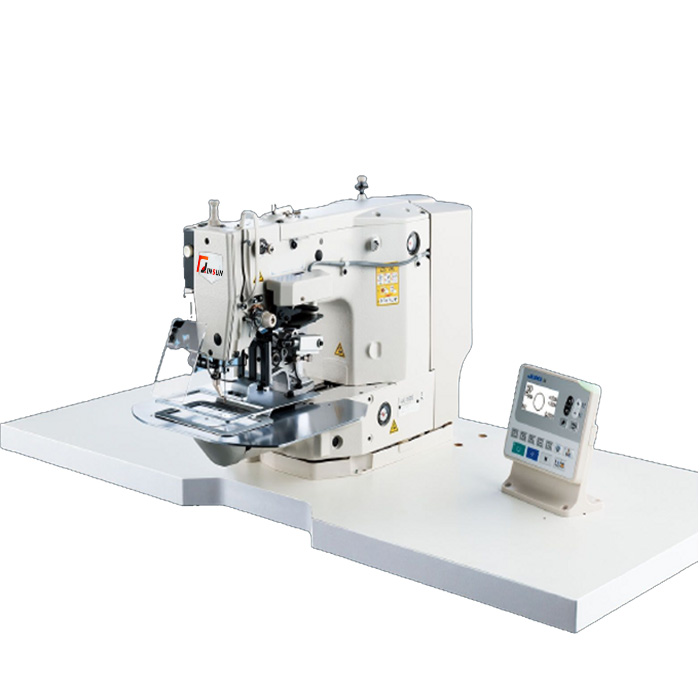
In the industrial sewing fields of clothing, bags, and footwear, achieving both robust stitching and efficient production in critical areas has always been a core focus of technological breakthroughs. The High Speed Lockstitch Bar Tacking Machine, a precision device specifically designed for reinforcement stitches, combines high-speed lockstitch stitches with an intelligent control system to increase the efficiency of traditional reinforcement processes several times over, becoming an indispensable "quality guardian" in modern industrial sewing production lines.
Technical Principle
The core principle of the High Speed Lockstitch Bar Tacking Machine lies in creating high-strength, tear-resistant reinforcement zones in critical areas of the fabric (such as pocket corners, trouser loops, and belt loops) through multi-threaded lockstitch stitches. Its technological implementation comprises three key modules:
Lockstitch System
The machine employs a double-thread lockstitch structure, where the top and bottom threads intertwine below the needle plate to form an "X"-shaped stitch. When the needle penetrates the fabric, the rotating hook precisely catches the top thread loop and wraps it with the bottom thread, forming a strong lockstitch knot. This type of stitch has a much higher tensile strength than single-thread chain stitch, making it particularly suitable for reinforcement areas subjected to frequent pulling. For example, in reinforcing the corners of jeans pockets, lockstitch can withstand a pull of over 50N without unraveling, while ordinary chain stitch may break under a pull of 20N.
High-Speed Drive and Precision Control
The equipment is equipped with a high-speed servo motor, reaching speeds of 4000-5000 rpm, which is 2-3 times faster than traditional reinforcement sewing machines. Through an electronic control system, the stitch length (0.5-5mm), stitch length (1-10mm), and sewing speed can be precisely adjusted to adapt to fabrics of different thicknesses (0.5-10mm) and materials (cotton, linen, synthetic fibers, leather). For example, when processing thick canvas bags, the equipment can automatically reduce the speed to 2000 rpm while increasing the stitch length to 3mm to ensure even stitching and prevent fabric jamming.
Intelligent Fabric Feeding and Presser Foot System
Reinforcement sewing requires completing complex stitches in confined areas (such as a 3cm x 3cm pocket corner), placing extremely high demands on fabric feeding precision. The machine employs a differential fabric feeding mechanism, achieving precise fabric movement in both the horizontal and vertical directions through independently controlled upper and lower feed dogs. Simultaneously, the presser foot pressure is adjustable (0.5-5N), capable of pressing down thin silk to prevent shifting while also accommodating the sewing needs of thick leather. For example, when sewing the corner of a leather wallet, the presser foot pressure is adjusted to 3N, and the feed dogs move at a speed of 0.5mm/needle, ensuring the stitches closely follow the corner's curvature.
Functional Characteristics
The high-speed lockstitch reinforcement sewing machine's functional design closely aligns with industrial production needs. Its core characteristics can be summarized as "three highs and one durability":
High-Efficiency Production
The equipment supports continuous operation, with a single reinforcement sewing time of only 2-3 seconds, more than 10 times that of manual reinforcement. For example, a factory producing 500 pairs of jeans per day can replace 30 skilled workers with 10 reinforced sewing machines, saving over one million yuan in labor costs annually. Furthermore, the equipment is equipped with an automatic thread trimming device, cutting off thread ends immediately after sewing, reducing downtime and further improving efficiency.
Precise Sewing
Through an electronic control system, the equipment can store over 20 sets of sewing parameters (such as stitch length, stitch position, and presser foot pressure). Operators can quickly switch processes by simply selecting the corresponding program. For example, when processing different styles of bags, the equipment can automatically adjust the stitch length from 1mm (fine sewing) to 3mm (rough reinforcement) without manual adjustment, ensuring consistent stitches.
High Adaptability
The equipment supports multiple stitch patterns, including 2-thread, 3-thread, and 4-thread, to meet various reinforcement needs. For example, the 2-thread mode is suitable for edge reinforcement of lightweight fabrics, the 3-thread mode is used for corner reinforcement of medium-thickness fabrics, and the 4-thread mode is designed specifically for thick leather or canvas, providing the highest strength sewing. Furthermore, the equipment is compatible with various needle sizes (from #9 to #18) and threads (from 20S to 100S), covering a wide range of materials from silk to leather.
Durable and Stable
The main body of the equipment is made of high-strength aluminum alloy casting, while key components (such as the hook, needle bar, and feed dog) are made of special steel with a quenching treatment, increasing wear resistance by more than 3 times. For example, the surface hardness of the hook reaches HRC60. allowing for 5000 hours of continuous operation without wear, while ordinary steel hooks can only maintain this for 2000 hours. In addition, the equipment is equipped with an automatic lubrication system that uses an oil pump to periodically deliver lubricating oil to key parts, reducing friction loss and extending service life.
Application Scenarios
High-speed lockstitch reinforced sewing machines have a wide range of applications, and their technological value permeates the entire industrial sewing process:
Apparel Manufacturing
In the production of jeans, work pants, and casual pants, the machine is used to reinforce pocket corners, trouser loops, belt loops, and other areas. For example, after a jeans factory introduced the machine, the rate of loose threads at pocket corners decreased from 3% to 0.1%, and customer complaints decreased by 90%. In addition, the machine can also be used to reinforce shirt collars and cuffs, improving garment durability.
Luggage and Bag Manufacturing
In the production of suitcases, backpacks, and handbags, the machine is used to reinforce handles, zipper pulls, corners, and other areas. For example, a bag manufacturer used the machine to sew leather handles; a single handle can withstand a pulling force of 50kg without breaking, far exceeding the industry standard (20kg). Furthermore, the machine can also be used to reinforce the edges of canvas bags to prevent fabric fray.
Footwear and Hat Manufacturing
In the manufacturing of athletic shoes, leather shoes, and hats, the equipment is used to reinforce parts such as shoe tongues, shoelace eyelets, and hat brims. For example, an athletic shoe factory uses this equipment to sew shoe tongues with a stitch density of 8 stitches per centimeter, ensuring the tongue won't unravel during frequent bending. Additionally, the equipment can be used to reinforce hat edges, improving wearing comfort.
Automotive Interiors
In the production of car seats, seat belts, and headliners, the equipment is used to reinforce seams. For example, an automotive seat factory uses this equipment to sew the edges of leather seats with a stitch tensile strength of 80N, meeting automotive safety standards. Furthermore, the equipment can be used to reinforce seat belts, ensuring they don't break in emergencies.
Technological Evolution
With the popularization of Industry 4.0 and sustainable development concepts, high-speed lockstitch reinforced sewing machines are upgrading towards "intelligent, green, and modular" directions:
Intelligent Control System
AI algorithms are introduced to achieve adaptive sewing. For example, the equipment can monitor fabric thickness and material in real time through sensors, automatically adjusting stitch length, thread length, and presser foot pressure without manual intervention. A high-end model already supports IoT functionality, allowing remote monitoring of equipment operation status via a mobile app, early warning of malfunctions, and reduced downtime.
Green and Energy-Saving Design
Low-energy servo motors and energy recovery systems are adopted. For example, a new type of equipment recovers braking energy for powering the lubrication system, reducing energy consumption by 20%. Furthermore, the equipment casing uses recyclable materials, complying with RoHS environmental standards and reducing environmental impact.
Modular Expansion
For special needs, the equipment supports functional module expansion. For example, a laser positioning device can be added to achieve precise alignment sewing; or an automatic feeding system can be integrated to achieve fully automated production from fabric feeding and sewing to finished product output.
High-speed lockstitch reinforced sewing machines, through the combination of lockstitch, high-speed drive, and intelligent control, provide an efficient, precise, and durable solution for industrial sewing. Their technological evolution has not only driven advancements in sewing processes but also helped the manufacturing industry upgrade towards higher efficiency and higher quality. In the future, with the integration of intelligent and green technologies, this equipment will play a crucial role in more fields, providing solid technical support for global industrial sewing.